


_edited.png)
The Brewers Won’t Go Away: Dodgers Face a 2–0 Deficit and a Dynasty in Danger

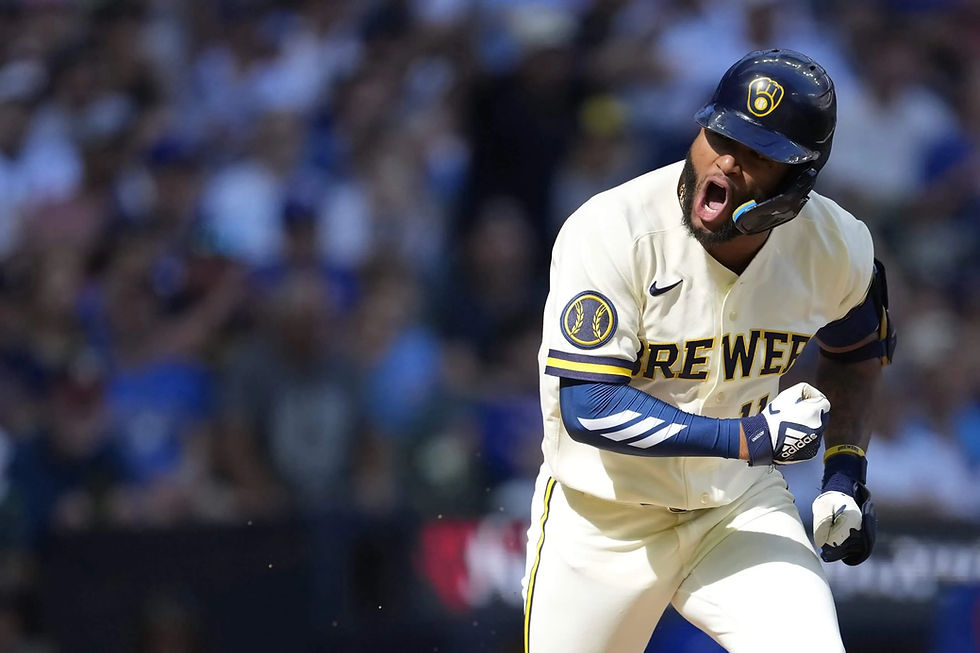
William Contreras delivers the knockout blows, the Brewers bullpen shuts the door, and baseball's most expensive superteam suddenly finds itself staring at elimination.
MILWAUKEE — The Los Angeles Dodgers were supposed to be chasing history. Instead, they're chasing the Milwaukee Brewers.
Two games into the National League Championship Series, the defending two-time World Series champions have discovered that a roster packed with superstar talent offers no protection against a team that refuses to play by the script.
Milwaukee's 7–4 victory Monday night at American Family Field pushed the Brewers to a 2–0 series lead, putting Los Angeles' bid for a third consecutive championship in immediate danger. William Contreras supplied the biggest swings. The Brewers' bullpen delivered another suffocating performance. And an offense built on pressure, contact and seemingly endless well-placed singles once again left the Dodgers searching for answers.
Call it the Milwaukee BABIP machine.
In baseball, batting average on balls in play measures how often a ball put into the field of play becomes a hit, excluding home runs, strikeouts and certain other outcomes.
Milwaukee has turned that statistic into a postseason talking point, stringing together soft-contact singles, timely base hits and relentless baserunning to punish opponents.
Some of those balls find holes. Others fall just beyond a defender's reach. The result, regardless of how pretty the contact looks, is the same: runners on base, runs across the plate and another Milwaukee victory.
For the Dodgers, the problem is no longer theoretical.
The Brewers are two wins away from the World Series. The defending champions have to find a way to stop them.
Contreras Turns the Series Into His Show
The Dodgers had opportunities to take control of Game 2. They even held a 4–3 lead entering the bottom of the fifth inning.
Then Contreras changed everything.
After Milwaukee had repeatedly chipped away at Los Angeles' pitching, the Brewers catcher launched a home run to left-center field to tie the game at 4–4. An inning later, with the game hanging in the balance, he delivered a go-ahead single that put Milwaukee in front for good.
It was a reminder that the Brewers' offense is not exclusively about fortunate bounces and awkwardly placed singles. When the opportunity presents itself, Milwaukee has players capable of delivering a decisive blow.
Contreras supplied both varieties Monday: the explosive home run and the clutch hit that broke the tie.
The Dodgers could not respond.
Los Angeles had entered the game expecting Yoshinobu Yamamoto to stabilize the series after Sunday's 2–1 loss. Instead, Yamamoto lasted just 2⅔ innings, allowing three runs as
Milwaukee repeatedly forced him into difficult situations.
The Brewers worked deep counts, reached base and made every mistake matter. Even when Los Angeles appeared to escape trouble, Milwaukee kept coming.
The message was unmistakable: the Dodgers could not afford to give the Brewers extra opportunities.
They did anyway.
The BABIP Machine Keeps Rolling
There is a reason Milwaukee's offensive approach has become such a fascinating postseason storyline.
The Brewers do not necessarily need to overpower a pitcher to beat him. They can manufacture runs through singles, walks, stolen bases, defensive mistakes and disciplined at-bats that gradually turn a routine inning into a problem.
Against Los Angeles, that approach has been devastatingly effective.
David Hamilton reached base repeatedly in Game 2, stole a base and helped generate additional scoring opportunities. Brice Turang continued to find ways onto the bases and deliver important hits. Christian Yelich supplied timely offense, while Contreras repeatedly made the Dodgers pay.
Not every ball was struck with authority. Not every rally followed a conventional script. But Milwaukee consistently found a way to turn traffic on the bases into runs.
That distinction matters because BABIP is not a measure of luck alone. Contact quality, speed, defensive positioning, batted-ball direction and the particular circumstances of a play can all influence whether a ball becomes a hit.
Soft contact can be fortunate. It can also be strategically useful, especially when combined with speed and pressure.
Milwaukee's challenge will be sustaining that production. BABIP can fluctuate dramatically over a short postseason sample, and balls that find grass today can become routine outs tomorrow.
But the Brewers do not need their formula to work forever.
They need it to work for two more wins.
The Bullpen Is Milwaukee's Real Superpower
If the Brewers' offense has supplied the chaos, their bullpen has provided the control.
Milwaukee's relievers have repeatedly neutralized Los Angeles after the Dodgers appeared poised to mount a comeback. In Game 2, four relievers combined to retire the final 15 Dodgers batters in order.
That is the kind of finishing performance that turns a narrow lead into a postseason statement.
Los Angeles has the star power to punish mistakes. Shohei Ohtani, Mookie Betts and Freddie Freeman represent a formidable challenge for any pitching staff. But a lineup's reputation means little when it cannot get runners home or string together enough hits against fresh relievers.
Milwaukee has made the final innings feel increasingly predictable: the Dodgers need a rally, the Brewers bring in another arm, and the game slips further away.
The bullpen's effectiveness also changes the way Milwaukee can manage the rest of the series. With leads protected late, the Brewers can lean into their strengths and force Los Angeles to play nearly flawless baseball.
For a team trying to win four games before losing four, that is an enormous advantage.
Los Angeles Has a Superstar Problem — and a Baseball Problem
The Dodgers' predicament is not simply that Milwaukee has been fortunate.
Los Angeles has failed to capitalize on its own opportunities.
In Game 1, the Dodgers went 1-for-6 with runners in scoring position and left nine runners on base. In Game 2, they again struggled to convert promising situations into decisive offense.
The result has been a series in which Milwaukee has repeatedly made the most of its chances while Los Angeles has left too much unfinished.
Ohtani's presence gives the Dodgers the ability to change a game with one swing. Betts can spark a rally. Freeman can deliver the extra-base hit that shifts momentum.
But October baseball is unforgiving. A lineup can be loaded with future Hall of Famers and still lose if it repeatedly fails to execute with runners aboard.
The Dodgers must also confront a pitching problem. Yamamoto's short outing placed additional pressure on the bullpen and forced Los Angeles to spend valuable pitching resources in a game it desperately needed to win.
Now the series moves to California, where the Dodgers must reset quickly.
Their championship experience remains valuable. Their talent remains undeniable. But neither guarantees a comeback.
Two Wins From the World Series, Milwaukee Has Nothing to Apologize For
The temptation will be to dismiss Milwaukee's success as a temporary statistical anomaly.
That would be a mistake.
Yes, the Brewers have benefited from balls finding holes and timely contact producing outsized results. Yes, some of those hits will eventually become outs. And yes, the
Dodgers have enough talent to reverse the series.
But Milwaukee also won a franchise-record 103 regular-season games, advanced through the National League Division Series and entered this rematch with a clear identity.
The Brewers play connected baseball. They pressure opposing defenses, make productive outs, exploit opportunities and trust their bullpen to finish the job.
Their approach might not look like the Dodgers' version of baseball. It does not have to.
The Dodgers built a roster designed to overwhelm opponents with elite talent. Milwaukee has built a team capable of making every inning uncomfortable.
Through two games, the Brewers' version is working.
The Dynasty Is Not Dead — But the Margin for Error Is Gone
A 2–0 deficit does not eliminate the Dodgers. The series now shifts to Los Angeles for Game 3 on Wednesday, giving the defending champions an opportunity to use their home crowd to change the atmosphere.
But the pressure is real.
Los Angeles must win four of the next five games to advance. Milwaukee needs only two victories to return to the World Series.
That difference changes everything.
The Dodgers cannot afford another game in which a strong start disappears, a promising rally stalls or the opposing bullpen turns the final innings into a shutdown operation.
They need their stars to produce. They need their starting pitching to go deeper. They need to turn baserunners into runs rather than leaving the game in the hands of a late-inning comeback.
Most importantly, they need to stop allowing Milwaukee to dictate the rhythm.
For the Brewers, the mission is simpler: keep making contact, keep applying pressure and keep trusting the arms waiting in the bullpen.
The BABIP machine does not need to look pretty. It just needs to keep working.
And if Milwaukee continues to find the gaps while its relievers erase every Dodgers threat, baseball's reigning dynasty could soon be watching someone else celebrate.
The Dodgers came into October chasing a three-peat.
Now, the Brewers are chasing history of their own — and Los Angeles is running out of time.

Comments