


_edited.png)

Houston Texans Swing for the Fences: What a Trade for Marvin Harrison Jr. Would Mean for C.J. Stroud and Houston’s Offense

The Houston Texans have emerged as a franchise with the talent to compete with the AFC's best, but one blockbuster move could raise the ceiling of their offense even higher.
Imagine the Texans acquiring Arizona Cardinals wide receiver Marvin Harrison Jr., the son of Pro Football Hall of Fame receiver Marvin Harrison, to give quarterback C.J. Stroud another premier weapon in the passing game.
Houston has officially made the move, acquiring Harrison from the Arizona Cardinals in a trade announced Oct. 12, 2026. The Texans sent a 2027 second-round pick and seventh-round pick to Arizona, receiving Harrison and a 2027 sixth-round selection in return. The deal is pending Harrison passing a physical, according to reporting from ESPN and other outlets.
The most intriguing element of this transaction isn't simply Harrison's potential. It's the relationship he already has with Houston's franchise quarterback.
Stroud and Harrison played together at Ohio State during the 2021 and 2022 seasons, developing chemistry before entering the NFL.
Both earned All-American recognition in 2022, and Houston is betting that their familiarity can help accelerate Harrison's transition into a new offense.
For a team seeking more consistency from its passing game, the reunion could prove significant.
Why Houston made the move
Harrison entered the NFL as the fourth overall selection in the 2024 draft, carrying enormous expectations after a standout college career.
However, his production in Arizona has not matched the projections attached to his draft position.
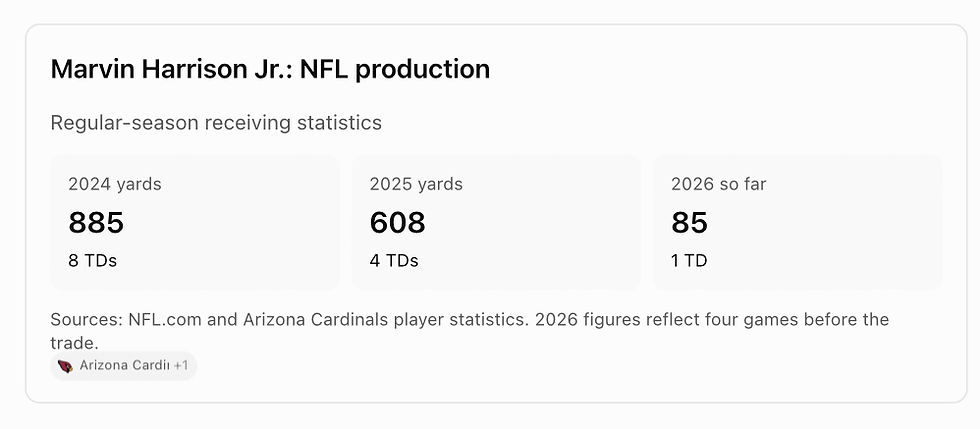
His first two seasons produced flashes of his considerable ability, but his role became less prominent in Arizona's offense. Through four games in 2026, Harrison had recorded just five receptions for 85 yards and one touchdown.
At 6-foot-3 and approximately 220 pounds, Harrison offers the size, body control and route-running potential to become a dangerous outside receiver. His ability to compete for contested catches could give Stroud another option on intermediate routes, deep throws and red-zone opportunities.
The move also gives Houston the opportunity to build a more versatile receiving group around Harrison and Nico Collins.
Collins has established himself as an important part of the Texans' passing attack. If Harrison develops into a reliable second perimeter threat, opposing defenses could face difficult decisions about coverage assignments.
Double-team Collins, and Harrison could find more favorable matchups. Give Harrison additional safety help, and Collins could benefit from more room to operate.
That is the potential value of this move: Houston could become harder to defend without needing Harrison to immediately produce as a superstar.
The familiarity between Stroud and Harrison adds another layer. Their shared college experience should help with communication and trust, although NFL defenses and offensive systems present challenges that college chemistry alone cannot solve.
The risk: Houston is buying potential, not proven production
This is an aggressive move, but it is not without risk.
Harrison's receiving totals have declined from 885 yards in 2024 to 608 in 2025 and 85 through four games in 2026. His limited recent production raises questions about his role, consistency and ability to command targets.
Houston also surrendered a second-round selection in the 2027 draft. That is meaningful compensation for a player who has yet to establish himself as a consistent top-tier NFL receiver.
The Texans must now determine whether Harrison's struggles were primarily the result of his situation in Arizona, his own development or some combination of both.
If the organization believes the talent that made him a top-four pick remains intact, the investment could pay off substantially. If his struggles continue, Houston will have sacrificed valuable draft capital without solving its offensive concerns.
The answer will not come from the trade announcement. It will come from Harrison's performance on Sundays.
What this means for Houston's playoff ambitions
The Texans' timing makes the transaction particularly interesting. Houston made the deal after defeating Tennessee 26-3, securing its first win following an 0-4 start to the 2026 season.
That victory and this acquisition give the franchise an opportunity to change the direction of its season, but the road back into contention remains challenging.
Harrison must learn the playbook, establish timing with Stroud and earn a meaningful role in the offense. Houston's coaching staff must also find ways to get him involved without disrupting the production of its existing playmakers.
The upside, however, is undeniable. A successful Harrison revival could give Houston a young receiving tandem capable of helping the offense compete with the AFC's best for years to come.
Final verdict: A high-risk move with high-reward potential
The Texans have made a bold investment in a former top-four draft pick whose best football may still be ahead of him.
Reuniting Harrison with Stroud gives Houston a compelling reason to believe the receiver can rediscover his form. But familiarity is not a guarantee, and potential is not production.
Houston gave up a valuable second-round pick to make this happen. Now the pressure shifts to Harrison, Stroud and the coaching staff to turn that investment into results.
My take: This is the kind of calculated gamble that can change a franchise's trajectory if it works. The Texans have acquired a receiver with first-round talent and a built-in connection to their quarterback. If Harrison finds his rhythm in Houston, this trade could eventually look like a bargain. If he doesn't, the cost will be difficult to ignore.
For now, Houston has made its move. The next chapter of Marvin Harrison Jr.'s NFL career begins in Texas.

Comments